
The whole picture
Three stages, one loop
Inbound adapters carry alerts, chats, and messages into Hyground. Agents reason over them, act in a sandboxed shell, and draw on your runbooks and past investigations. What comes back is a filed ticket, written documentation, or an answered thread. Nothing leaves your cluster.
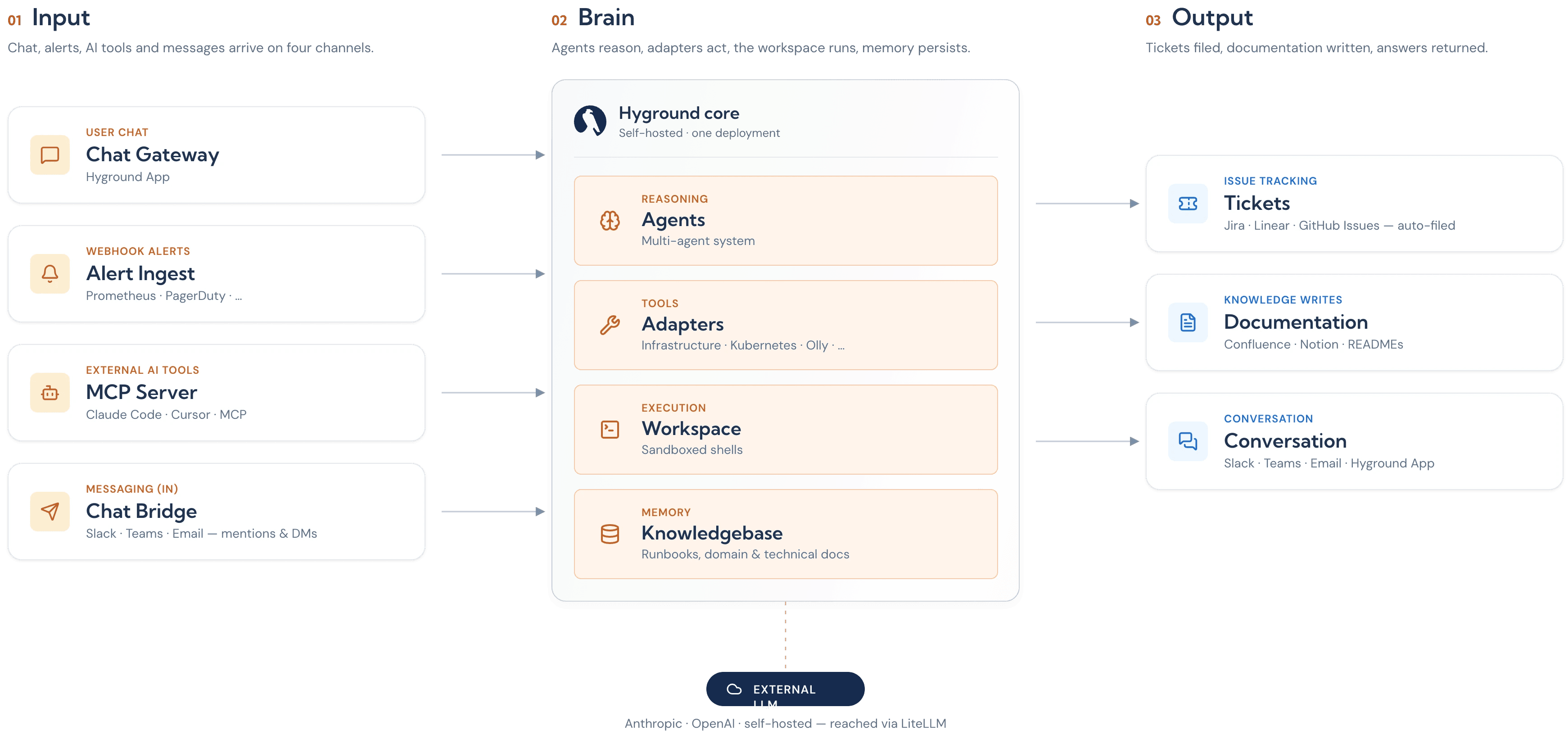
Bring your own model
Agents reach their model through LiteLLM, so the choice stays yours: Anthropic, OpenAI, Google, or a model you host yourself. Swap providers without touching the rest of the system. No vendor lock-in, no data sent to a model you didn't pick.

Inside Hyground
Four parts do the work: agents that reason, adapters that read your systems, a sandbox where they act, and a memory of how you operate.
A real run
Same incident. Different experience.
What it takes to get from an alert to a structured root cause, with and without Hyground in the loop.
Without Hyground
00:00
Alert fires. The on-call engineer is paged and starts switching between dashboards.
+5m
Logs and metrics opened in separate tabs. Manual filtering for the affected service starts.
+15m
Cross-team Slack thread spun up to find someone who knows the service and the recent changes.
+45m
Timestamps correlated by hand across logs, traces and deployment history.
+2h
A likely root cause emerges after trial and error and a hunt through old incident notes.
+3h
Findings written up manually. The Jira ticket is filed and the post-mortem is scheduled.
Total time: around 6 hours
Heavily dependent on who is on-call and what they remember from the last similar incident.
With Hyground
00:00
An alert arrives at the ingest endpoint. The payload passes an injection and jailbreak check before any work starts.
+30s
The agent plans the investigation and executes it.
+2m
Logs, metrics, traces and deployment history are queried in parallel from a read-only execution environment.
+4m
Relevant runbooks and past investigations are pulled from the knowledge base, so the reasoning is grounded in how your systems actually work.
+6m
A structured root cause is delivered: affected services, supporting evidence, recommended next actions, every step recorded.
+1h
A post-mortem draft is written automatically from the investigation: timeline, root cause, contributing factors, action items.
Time to root cause: around 6 minutes
Every step runs inside your cluster. Every query, every piece of evidence, every reasoning step is recorded and replayable.
Eyebrow
Connected to everything you run
The same loop plugs into the tools your team already lives in, inbound and outbound.
Self-hosted & sovereign
Security is enforced at the architecture level
Hyground ships as a Kubernetes Helm chart and runs entirely inside your perimeter. There is no Hyground SaaS in the path: no control plane, no phone-home, no operator access into your cluster.
